
Authors
Jakub Arbes | A.M. Bakalar | Balla | Beata Balogová | Adam Bodor | Yaryna Chornohuz Agnieszka Dale | Ivana Dobrakovova | Artur Dron' | Karel Jaromír Erben | Thea von Harbou Daniela Hodrová | Petra Hůlová | Jan Křesadlo | Andriy Lyubka | Karel Hynek Mácha
Božena Němcová | Jiří Pehe | Gustav Reuss | Jaroslav Rudiš | Krisztina Tóth | David Vaughan
AUTHOR OF THE SEASON
Yaryna Chornohuz
Born in 1995, Yaryna Chornohuz is a poet and translator who is currently serving as a Senior Corporal and drone pilot in the Ukrainian Armed Forces. Her second collection of poetry, [dasein: defence of presence], was published in 2023 and went on to be joint winner of the Taras Shevchenko Ukrainian National Award for literature in 2024. Her third collection of poetry, Night Saffron, was published in 2025, and her translation of Sylvia Plath’s Ariel is forthcoming.
![[dasein: defence of presence]](https://static.wixstatic.com/media/89b88c_d495d2adfa4f4e3ba0f8e982d6b302f5~mv2.png/v1/fill/w_299,h_328,al_c,usm_0.66_1.00_0.01/89b88c_d495d2adfa4f4e3ba0f8e982d6b302f5~mv2.png)

Jakub Arbes
Jakub Arbes (1840 – 1914) was a Czech writer and intellectual. He studied philosophy and literature in Prague and worked as a journalist and at times as the editor-in-chief of prominent Czech political ad literary magazines. After spending 15 months in prison for opposing the Austro-Hungarian Empire, he left for France and joined other ‘Bohemian Partisans’. He translated many of Edgar Allan Poe’s writings into Czech and was strongly influenced by his friend, Zolas’s theory of the experimental novel.
Arbes is known as the creator of the literary genre called the ‘romanetto’, which anticipates many of the devices of later detective science fiction. Mostly set in Central Europe, his works typically feature a gothic mystery solved through logical deduction, introducing technical knowledge and scientific reasoning into modern literature.
First published in 1877, Newton’s Brain is recognised as the first science fiction work published in the Czech language. It was published in English, by Jantar in 2023.


(Photo: Mariusz Smiejek)
A.M. Bakalar was born in Poland and lives in London. Her first novel Madame Mephisto was published in 2012 and was a reader nomination for the 2012 Guardian First Book Award. In 2015 her short story ‘Woman of Your Dreams’ was broadcast on BBC Radio 4 and her writing has appeared in The Guardian and The International New York Times. She has also appeared as a guest on BBC Radio 3 Night Waves, Proms Plus Literary and BBC Radio 4 At Home Abroad. A.M. Bakalar’s second novel Children of Our Age is published by Jantar in October 2017.

Balla
Vladislav Balla, who goes only by his surname, is a graduate of the Bratislava Economic University and has a day job in the local council’s audit office in Nové Zámky, a provincial town in southern Slovakia. Since his first short story collection, Leptokaria (1996), he has published eleven more books, mostly of short fiction. His works have been translated into Czech, German, English, Hungarian, Polish, Slovene and Serbian. The novella V mene otca [2012, In the Name of the Father] was voted Book of the Year by the Slovak daily SME in 2012 and in the same year awarded both the Tatrabanka Foundation Art Prize for literature and Anasoft Litera Prize, Slovakia’s most prestigious literary prize. Balla’s latest, the novella Veľká láska [Big Love], was published in 2016 and was also shortlisted for Anasoft Litera. Je mŕtvy ([Dead] was first published in Slovak in 2018 and Medzi ruinami [Among the Ruins].
In a survey review of all Balla’s titles published in The TLS, Kate Murphy described his novels as ‘something to love’.


(Photo: Lucia Gardin)

Beata Balogová
Beata Balogová is an award-winning journalist, writer, and advocate for press freedom. From 2014 to 2025, she served as editor-in-chief of SME, one of Slovakia’s leading daily newspapers and news websites, and she currently works as its chief commentator. Prior to joining SME, she was editor-in-chief of Slovakia’s English-language weekly, The Slovak Spectator, from 2003 to 2014.
Beata began her journalism career at the age of eighteen and has remained deeply committed to the profession ever since. She holds a master’s degree from the Columbia University Graduate School of Journalism and was a Fulbright scholar at the University of Missouri School of Journalism in 1994.
An ethnic Hungarian living in Slovakia, she writes extensively on politics, social change, populism, and human rights. She is a frequent speaker at international journalism forums and conferences, where she addresses challenges to press freedom in her home country and across Central Europe.
Beata is the author of The Cornelias (Kornélie), an autobiographical novel published in 2022 and translated into Polish, Serbian, and Czech, as well as The Book Full of People (Kniha plná ľudí), a work of non-fiction.
She received the 2020 European Press Prize for Opinion and has been honored with three national journalism awards in Slovakia. Her novel Cornelias received the Golden Pen Award from the Ikar publishing house for best novel of the year. She currently serves on the board of the European Press Prize and was deputy chair of the executive board of the International Press Institute from 2016 to 2022.
The Cornelias will be published by Jantar in the autumn of 2027.

Ádám Bodor
Ádám Bodor is an author of Transylvanian origin, born in Kolozsvár (today Cluj, Romania) in 1936. He is arguably Hungary’s greatest living writer. He was 16 when sent to a Romanian prison as a political criminal from 1952 to 1954. He has been living in Hungary since the early 1980s.
In the 1990s, he became familiar to the wider reading public after the publication of his novels Sinistra Zone (1992), The Visit of the Archbishop (1999), the most comprehensive collection of his short stories to date, Back to the Long-eared Owl (1997), as well as a confessional, autobiographical piece which was eventually given an interview form (The Smell of Prison, 2000).
Bodor’s books have been published in more than twenty languages. Several of his works were made into films, including Zoltán Kamondi’s Dolina, based on Bodor’s novel, The Visit of the Archbishop.
Bodor has won all the major Hungarian Literary awards including Hungary’s top award, Kossuth Prize in 2003.
The Birds of Verhovina was published by Jantar in 2021.


Yaryna Chornohuz
Born in 1995, Yaryna Chornohuz is a poet and translator who is currently serving as a Senior Corporal and drone pilot in the Ukrainian Armed Forces. She participated in the Maidan Revolution of Dignity in 2014 and would have joined the army at that point, had not Russia’s occupation of Crimea coincided with her giving birth to her daughter. She studied philology as well as literature and philosophy at the Kyiv-Mohyla Academy during which time she also wrote poetry and translated English literature into Ukrainian.
In 2019, during the second year of her Masters, she began her military service by joining the volunteer paramedic Hospitallers Medical Battalion. In early 2020, after her partner was killed in action by a Russian sniper, she began what was at first a one-woman protest outside the near the Presidential Office in Kyiv to protest against Volodymyr Zelensky’s policy at the time of allowing pro-Russian representatives of the separatist authorities in Dontesk and Luhansk into peace discussions. Despite lockdown restrictions and no invitation, 500 other protestors eventually joined her. 2020 was also the year of the publication of her first collection of poetry, How the Military Circle Bends, inspired by her service on the front line.
Her partner’s death in action led to her joining the 503rd Battalion of Ukraine Marine Corps, following 6 months’ intensive training to NATO standards in 2020-21. She earned her beret in 2021, becoming the only woman in her battalion. She was serving in the 140th Marine Reconnaissance Battalion at the time of the full-scale invasion of 24 February 2022 and participated in fierce battles in Popasna, Mariupol and Bakhmut. In 2022 she and three other female Ukrainian soldiers travelled to the USA to appeal to US Congress for more weapons and armour. She has been awarded medal for life saving (May 2022) and for military service to Ukraine (April 2023), by decree of the President of Ukraine, and a Badge of Honour by the Minister of Defense of Ukraine (September 2023).
Yaryna Chornohuz’s second collection of poetry, [dasein: defence of presence], was published in 2023 and went on to be joint winner of the Taras Shevchenko Ukrainian National Award for literature in 2024. Her third collection of poetry, Night Saffron, was published in 2025, and her translation of Sylvia Plath’s Ariel is forthcoming.


Agnieszka Dale
Agnieszka Dale (née Surażyńska) is a Polish-born London-based author conceived in Chile. Her short stories, feature articles, poems and song lyrics were selected for Tales of the Decongested, The Fine Line Short Story Collection, Liars' League London, BBC Radio 4, BBC Radio 3's In Tune Live from Tate Modern, and the Stylist website. In 2013 she was awarded the Arts Council England TLC Free Reads Award. Her story “The Afterlife of Trees” was shortlisted for the 2014 Carve Magazine Esoteric Short Story Contest and longlisted for the Fish Short Story Prize 2014.


.jpg)
Ivana Dobrakovova
Ivana Dobrakovova (1982) graduated from Bratislava's Comenius University with a degree in English and French (translation and interpretation). She is based in Turin where she works as a freelance translator from French and Italian into Slovak, notably of Elena Ferrante’s highly successful Neapolitan saga. She debuted in 2009 with her short story collection Prvá smrť v rodine (The First Death in the Family), followed by the novel Bellevue (2010) and in 2013 Toxo, a collection of short stories. She has won several literary competitions, including Poviedka 2008, and all four of her books have been shortlisted for the Anasoft Litera prize. In 2019, she was awarded the EU Prize for Literature for Matki a kamionisti (Mothers and Truckers 2018). Jantar published Bellevue in 2019 and Mothers and Truckers in 2022.


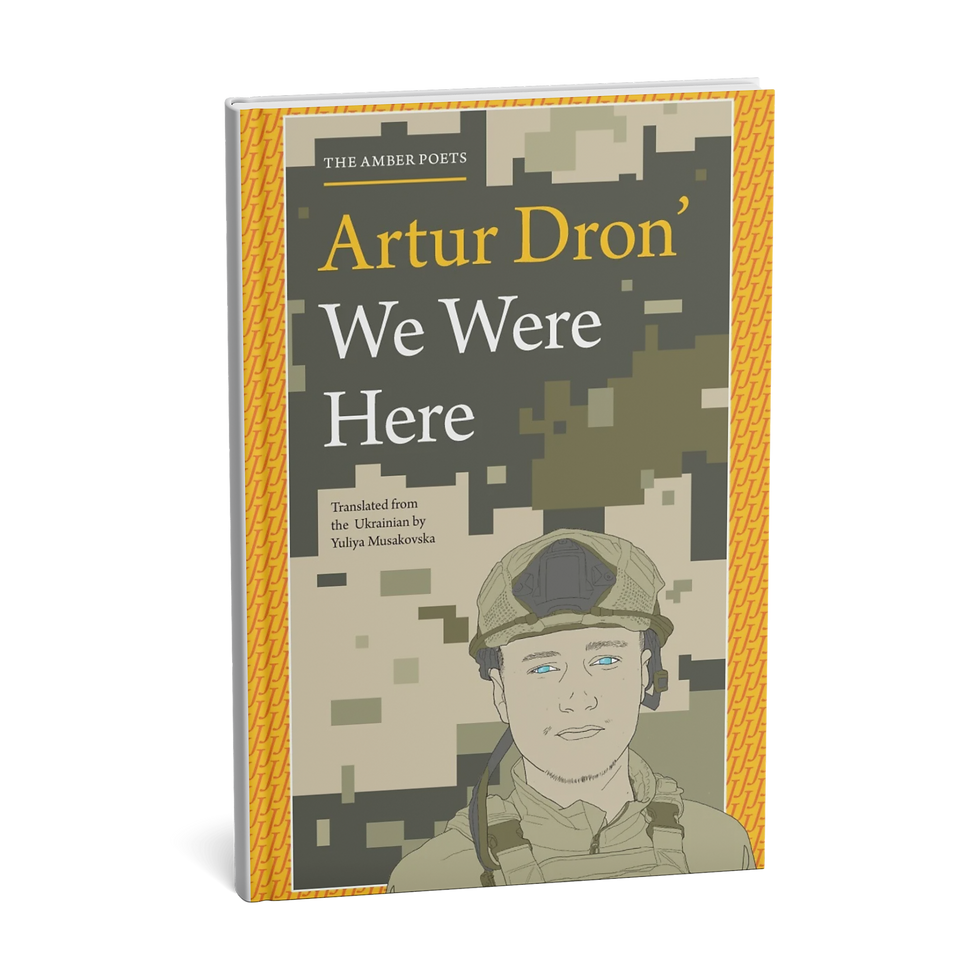
Artur Dron'
Artur Dron' is a young poet and a rising star of Ukrainian literature. Born in the Ivano-Frankivsk region, Dron moved to Lviv at age 17 to study journalism at the Ivan Franko National University of Lviv graduating in the summer of 2021 and joining Old Lion Publishing House as an event manager. Shortly after the February 2022 invasion, Artur volunteered for the Armed Forces of Ukraine, joining the 125th Separate Territorial Defence Brigade and deployed in the Kharkiv, Donetsk, and Zaporizhzhia region. In October 2024, he was seriously wounded by an anti-personnel mine near Levadne, sustaining severe shrapnel injuries to his hand and forearm. Following surgeries and rehabilitation, he was demobilised in the summer of 2025.
He has published two books of poetry and one book of prose. In December 2025, he was awarded the Yuri Shevelyov Prize for Nonfiction for 'Hemingway Knows Nothing'. Jantar will publish its English translation in September 2026.


Karel Jaromír Erben
KJ Erben (1811-1870) was a noted folklorist, poet and activist during the nineteenth Czech National Revival. His collection, Kytice, is considered one of the most significant poetry collections in modern Czech literature. Along with The Grandmother by Božena Němcová (Jantar 2025) and Mácha’s May , it is regarded as one of the three foundation texts of modern Czech-language culture. The collection inspired the composer, Antonín Dvořák to write four of his most famous works, the symphonic poems, The Water-goblin, The Noonday Witch, The Golden Spinning-wheel and The Wild Dove.
As Geoffrey Chew notes in his introduction, ‘Erben, one of twin boys, sons of a shoemaker, was born in the town of Miletin near Jitschin [Miletín u Jičína] on 7 November 1811, and died in Prague on 21 November 1870. He received his elementary education (including instruction in music) at a school where his grandfather and uncle were teachers, and proceeded from there to Gymnasium at Königgrätz [Hradec Králové] (1825–31), supporting himself by giving music lessons. At Prague University he studied arts and law (1831–3), and encountered outstanding members of the younger generation of those writing in Czech, including K. H. Mácha and the dramatist Josef Kajetán Tyl, as well as some of those writing in German.
Erben’s vocation was in the first place as an archivist, antiquarian and folklorist, rather than as a poet. He became an assistant to the historian František Palacký, famous ‘father of the nation’, assembling material from provincial and rural archives in Bohemia, and this work made it possible for him to work as an active ethnologist, collecting Czech folk-songs, which he began to publish from 1841,3 and Czech and other Slavonic folk legends, along lines established by the brothers Grimm, which he published from 1844.4 In 1848, the year of revolutions, he was involved in the abortive Prague Slavic Congress [Slovanský sjezd] of which Palacký was president; subsequently, like Palacký, he retreated from active political engagement. From the 1850s Erben was employed as an archivist in Prague. Working at the National Museum, he edited numerous older Czech texts, including the complete writings in Czech of the reformer Jan Hus, wrote entries, principally on mythology, for the first Czech encyclopedia (the so-called Riegrův slovník naučný, published from 1860), and translated texts from other Slavonic languages.
Jantar published Kytice in three separate editions in 2013, 2020 and 2025


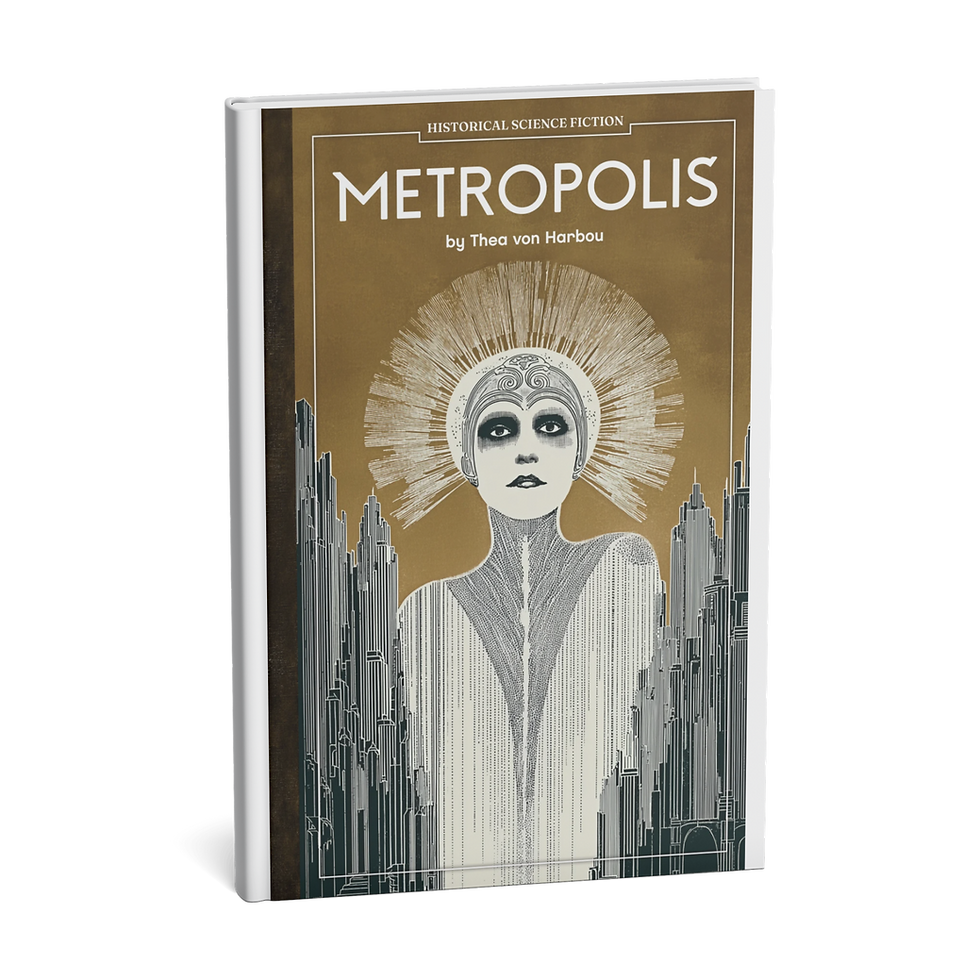
Thea von Harbou
Born December 27, 1888 to a family of minor nobility, von Harbou was something of a child prodigy, placing a short story in a magazine and privately publishing a collection of poetry by 13.
As Sanders Isaac Bernstein writes in his introduction, ‘in her adolescence, she took the stage, touring Germany, and then rose to national prominence during World War I for writing a series of novels about patriotic women. She met Fritz Lang, her second of three husbands, when they were working on adapting one of her novels, The Indian Tomb (1921), into a film, the beginning of one of the most successful artistic partnerships of the era—if not of German film history—responsible for such classics as Dr Mabuse, the Gambler (1822), The Nibelungen (1924), and M (1931). It only ended when the womanizing Lang could not tolerate von Harbou’s only affair—with the Indian journalist, Ayi Tendulkar, who would become her third husband. Despite little evidence of overt antisemitism, she willingly joined the Nazi party, and, known then as the “Queen of the Screenwriters,” worked on over 30 projects between 1933 and 1945, including consulting on the notorious hate film, Jüd Süß. When she died in 1954 from a brain aneurysm, she still defended her Nazi-era actions.
Metropolis was published by Jantar in the year it was set, 2026, in a special anniversary edition. The third of Jantar’s SF series.


(Photo: Elena Sokol)
Daniela Hodrová
Daniela Hodrová was a literary scholar of French, Russian and comparative literature and prize-winning author. She is best known for her City of Torment trilogy described by the critic, Declan O’Driscoll in his review in the Irish Times, as ‘a novel of exceptional brilliance’. It was first published by Jantar in 2020. Her alternative guide to Prague, Prague I See a City, was the first book published by Jantar in 2011.
Copies of her last Czech novel, What's Coming or the Journey to the Magic Hill were printed in time for her to see before she died. She wrote nine other novels, one ‘alternative guidebook’ (Prague, I See a City, Jantar 2011 and 2015) and several academic monographs on various aspects of the European novel, in particular the novel of initiation, as well as mythopoetics of the city. Her novel Spiral Sentences won the most prestigious Czech literary award, Magnesia Litera, in 2016. She was awarded the Franz Kafka Prize in 2012 and the (Czech) State award for Literature in 2011. She was nominated regularly for the Nobel Prize by the Czech Republic.
She was born in Prague into the family of actor Zdeněk Hodr. In her youth, she considered a career as an actor, and after studying languages (Russian, Czech, French) and comparative literature at Charles University, she worked as an editor at Odeon publishing house. From the mid-1970s she worked at the Institute for Czech Literature of the Academy of Sciences. Her husband was the writer, poet and translator Karel Milota died in 2002.


Petra Hůlová
Petra studies languages, culture and anthropology at universities in Prague, New York and Ulan Bator and was a Fulbright scholar. Her work frequently uses first-person narrators and addresses social and political issues from a feminist perspective.
Petra has written 11 novels published in Czech. She has won numerous awards in her home country and her work has been published in 13 languages. Three of her novels have been translated into English by Alex Zucker:
All This Belongs to Me (Northwestern University Press, 2009): A family saga set in Mongolia, told from the perspectives of five different women.
Three Plastic Rooms (Jantar, 2017): A novel exploring sex work, consumerism, and neoliberalism in a post-socialist context.
The Movement (World Editions, 2021): A feminist dystopia that has been compared to The Handmaid’s Tale.


(Photo: Pinkava estate)
Jan Křesadlo
Jan Křesadlo (1926–1995) was the pseudonym chosen by Dr Václav Jaroslav Karel Pinkava, a Czech emigré psychologist who settled in Britain with his wife and four children after the 1968 invasion of his native Czechoslovakia. He worked as a clinical psychologist in Colchester until his early retirement in 1982, when he turned to full-time writing. GraveLarks, his first novel, was originally published by Josef Škvorecký’s émigré publishing house ‘68 Publishers in Toronto. Pinkava was also active in choral music and mathematical logic discovering the many-valued logic algebra which bears his name.


Andriy Lyubka
Andriy Lyubka is a Ukrainian poet, essayist, and translator. He grew up in Vynohradiv, in South-Western Ukraine, and then enrolled at the Uzhhorod National University, where he studied Ukrainian Philology. His second master's degree in Balkan Studies was received from Warsaw University in 2014. He is the author of four collections of poetry, one book of short stories, Saudade, and six novels. His best known novel Carbide depicts the daily life of smugglers in Zakarpattia Oblast, south-west Ukraine on the borders of Slovakia and Hungary.
After the Russian invastion of Ukraine in 2022, Andriy became active as a volunteer fundraiser. He joined the Ukrainian Army in February 2026.
Carbide was published by Jantar in 2020.


Karel Hynek Mácha
Karel Hynek Mácha (1810 – 1836) was arguably the founder of modern Czech literature, and the greatest figure in literary Czech Romanticism. Gypsies (1835) is his most substantial prose work and is comparable to his best known work, the epic poem, May (1836). He died at Litoměřice in 1836, after contracting an infection. His premature death, European literary culture lost a prodigy of astonishing promise.


Božena Němcová
Božena Němcová was a Bohemian writer of the final phase of the 19th Century National Revival Mmovement. In addition to being a hugely important author and journalist, she was a notable campaigner for the education of young girls and co-founded the first Girls’ Grammar School in Prague.
As Julia Sutton-Mattocks writes in her introduction, ‘The birth date of Božena Němcová has long been contested by scholars. Most biographies of Němcová begin by mentioning her birth certificate, which states that she was born Barbora (Barunka) in Vienna in 1820 to a Czech servant mother (Terezie Novotná, 1797–1863) and Austrian coachman father (Johann Pankel, 1794–1850). It is not enough simply to say when and where the writer was born, since other documents (including her school records) indicate that her true date of birth could have been as early as 1816. This discrepancy has led to significant speculation over Němcová’s parentage and to a proliferation of alternative origin stories for her. Among the suggestions put forward are, to quote Libuše Heczková, ‘more than fifty parasitic theories’ alleging that she was of illegitimate aristocratic birth. One of the other more outlandish theories is that she was the daughter of the Spanish painter Francisco Goya (1746–1828).’
The Grandmother was published by Jantar in 2025. Two prominent previews have been published already. The first, by Donald Rayfield in Literary Review concludes: ‘Thanks in part to Susan Reynolds’s haunting new translation, the novel stays in the deep parts of the memory, as if one had not read but dreamed it.’
The second review appeared in Asymptote in February 2026. Its final paragraph is ‘Božena Němcová’s The Grandmother is unequivocally the gift that keeps on giving. It is a novel of fragments, yet a cohesive whole. Its didactic moments are not moralistic, but the genuine transmission of lessons gained over time. It is an extollation of a whole people whose language, identity, and existence has withstood a subterfuge erasure. It is an oral folk tale transposed into the written. It is perennial. It is the best book the anglophone literary space has never heard of—and one that it owes itself to read.’


Jiří Pehe
Jiří Pehe is a Czech political analyst and writer. He was born in Rokycany in Czechoslovakia. He studied law and philosophy at Charles University in Prague, where he earned a doctorate in 1980. In September 1981, he fled Czechoslovakia through Yugoslavia to Italy.
After a short stay in a refugee camp near Rome, he arrived with his wife, Jana, in New York in the US. Until 1983 he worked as a night receptionist at the Algonquin Hotel in New York. Later, he attended School of International Affairs at Columbia University in New York, from which he graduated in 1985.
From 1985 to 1988, Pehe worked as the head of East European Studies for the human rights organisation, Freedom House in New York. Then, from August 1988, he worked as an analyst for Radio Free Europe/Radio Liberty in Munich. In November 1989, Jiří became the organization’s head of Central European Research and Analysis. After Radio Free Europe moved its headquarters from Munich to Prague in 1995, he moved back to the Czech Republic.
From 1995 to 1997 Jiří served as the director of the Analysis and Research Department at the Open Media Research Institute in Prague. From 1997 to 1999, he was the director of the Political Cabinet in the office of Czech President Vaclav Havel and continued serving as Havel's external political advisor until the end of Havel's term in 2003.
Jiří has written numerous essays and papers that have appeared in newspapers and academic publications around the world and frequently comments on political developments for Czech television, radio, and the international media. In 2024, he received “the best Czech political commentator” award from Open Society Foundation.
He has also published five books on politics and six novels. His novel Three Faces of an Angel was published in English by Jantar Publishing in London in 2011. His latest novel Zpráva posledního člověka (Report of the Last Man), was published in 2025 by Prague’s Prostor Publishing House.
Between 1999 and 2025 Jiří Pehe was director of New York University in Prague and Global Professor at the Center for European and Mediterranean Studies at NYU in New York. For ten years, between 1999 and 2009, he headed the board of Forum 2000, an organization that organised international conferences under Havel’s auspices. In 2011 he founded the think-tank CESTA, which he headed for three years.
Jiří Pehe lives in Prague. His second wife, Thea, is American. He has two daughters: Veronika for his first marriage, and Isabella from his second marriage.


Gustáv Reuss
Gustáv Reuss (1818 – 1861) was a Slovak doctor, botanist and polymath, writer and most significantly, the founder of Slovak Science Fiction as a popular literary genre. He was born in Revúca as one of three sons of the enlightened Lutheran priest Samuel Reuss, who corresponded with Johann Wolfgang Goethe and helped found the Revúca Lutheran Library, the first public library in Slovakia.
After studying at universities in Pest and Vienna, Reuss practiced medicine in Revúca and Miskolc, while also pursuing his interest in botany. He collected over 4,000 plants, classifying some 2,000 and coining many botanical terms in Slovak in his Května Slovenska(The Flora of Slovakia), the first comprehensive Slovak book on botany, published in 1853. Under the influence of his father, Reuss and his brother Ľudovít collected legends and fairytales of the surrounding Gemer region. The result, Codex Revúcké, is a collection of Slovak folk tales, rumours, sayings and proverbs.
In an effort to revive Slovak as a literary language, Reuss began to draft a novel based on the textbook of the astronomer J Littrow published in the early 1850s. His goal was to present up-to-date knowledge of astronomy in accessible language.
The happy conclusion is The Science of the Stars published by Jantar in 2023.


Jaroslav Rudiš
Jaroslav is a German-Czech author, playwright and musician who has won numerous awards for his fiction, plays and music. He studied German and History at University and previously worked as a teacher and a journalist.
In 2021, he was awarded the Order of Merit of the Federal Republic of Germany by Federal President Frank-Walter Steinmeier in recognition of his cultural contribution to Germany.
Winterberg’s Last Journey was originally written in German and published in 2019. It was published by Jantar in 2024 and received excellent reviews. The London Magazine described it as From The London Magazine August 2024 as 'excellent writing'. While the TLS described it 'an abiding and romantic affection for the history of European railways’.
The Spectator described Winterberg’s Last Journey as 'a beautiful tragicomedy’.


Krisztina Tóth
Krisztina Tóth is one of Hungary’s most accomplished, popular and respected writers and an outspoken public intellectual, engaged particularly with the struggle for women’s rights and the increasingly severe restrictions on cultural autonomy in Hungary. Barcode, first published by Jantar in 2023 is her first prose collection, a collection of short stories about boundaries and how to navigate them. It was longlisted for the Republic of Consciousness Prize, shortlisted for the Warwick Women in Translation Prize and a finalist for the 2024 EBRD Literature Prize.
Her first poetry collection, published at the age of 22, won the Radnóti prize and she has since garnered a dozen or more major awards for her poetry, prose and (often taboo-breaking) books for children.
She is also a translator of French literature, while being widely translated herself: 26 books in 15 languages.
A new play The Bat was published by Bloomsbury in 2024, as part of a collection of “Difficult women and resistance dramatic voices” from contemporary Hungary. Another collection of short stories, Pixel, was published in 2016.
A novel, Eye of the Monkey, was published by Seven Stories Press in 2025 and My Secret Life: Selected Poems was published by Bloodaxe in 2026.


David Vaughan
David Vaughan is a writer and broadcaster. A former BBC Prague correspondent, he was editor-in-chief of the international service of Czech Radio for eight years. He studied Modern Languages at Balliol College, Oxford and is also fluent in Czech, having lived in Prague since 1991.
Hear My Voice is his second book set in the tense atmosphere of Central Europe on the eve of WWII.
It was published by Jantar in 2019. The Czech version of Hear My Voice was awarded the Czech Book Readers Prize in 2015.
